Sleep science · Mattress basics
Pillow-Top Organic Mattresses: How the Comfort Layer Changes the Feel
A mattress is more than the sum of its materials. Its core establishes the foundation; the layers above it shape the first impression—the gentle give, the pressure relief, the way a shoulder settles or a hip meets resistance. On a pillow-top organic mattress, that distinction is especially visible: a separate cushioned layer is sewn onto the mattress surface, changing how the bed feels without necessarily changing the support beneath.
Published November 17, 2026
A familiar silhouette, a different surface
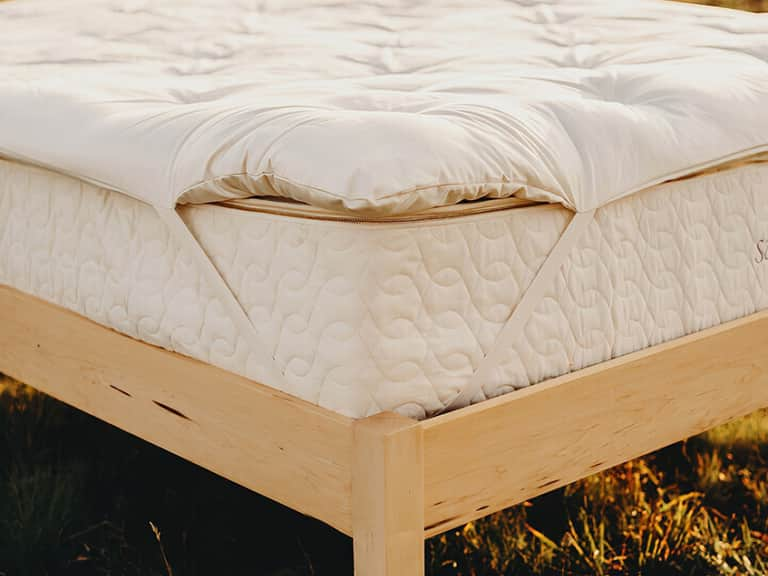
A pillow-top mattress has a distinct, often softly rounded layer attached to its upper surface. The name can suggest a pillow resting on the bed, but the comfort layer is generally integrated into the mattress construction rather than being a loose cushion. It may contain foam, fiber, wool, latex, or combinations of materials, enclosed in fabric and stitched or otherwise secured to the mattress.
That added layer changes the sensation at the point where a sleeper first meets the bed. A firm mattress with a cushioned top may feel more yielding than a similarly firm mattress with a thin, taut surface. The difference is not simply softness. The added materials influence how quickly the surface responds, how deeply the body settles, and how pressure is spread across areas such as the shoulders, hips, and heels.
The underlying support system still matters. A pillow-top cannot, by itself, tell you whether a mattress will maintain a comfortable sleeping posture. That depends on the core and on how the complete mattress responds to a particular body, sleeping position, and movement pattern. The top layer modifies the encounter with that foundation; it does not replace the foundation.
In an organic mattress, the term “organic” refers to particular materials or certifications, not to one universal recipe. A mattress may include certified organic fibers in its cover or comfort layers, while other components have different material specifications. Construction varies. Reading the details is more revealing than relying on a label or the pillow-top shape alone.
What the comfort layer does
When someone lies down, the mattress responds to weight and shape. A comfort layer cushions the body’s contact points and can help distribute pressure over a broader area. The effect depends on the material’s resilience, density, thickness, quilting, and the firmness of the layers below it.
A responsive material tends to compress under load and push back as the load changes. Other materials may allow a slower or more enveloping sensation. Fiber batting can create a softly padded surface; latex often has a buoyant, springy character; wool can compress while also managing moisture and helping moderate temperature. These are general tendencies, not guarantees: formulation and construction make a substantial difference.
Thickness is part of the equation, but it is not a complete measure of comfort. A thick layer made from a resilient material can feel quite different from a thin layer of a softer material. Quilting can also alter the first few moments of contact, while the support core becomes more noticeable as the body settles. For that reason, mattress descriptions are useful starting points, not substitutes for understanding the complete design.
It can help to think in terms of two related questions. First, what does the surface feel like when you lie down? Second, what happens after you have settled into your usual position? A mattress that feels inviting at first may not provide the kind of sustained support that feels comfortable over time. Conversely, an initially firmer surface may become more agreeable once its layers respond to the body.
Pressure relief and support are partners
People often describe mattress comfort as a choice between “soft” and “firm.” The experience is more complex. Comfort involves the relationship between cushioning and support: enough give at pressure points, alongside enough resistance to keep the body from settling into an uncomfortable position.
A pillow-top can soften the surface sensation and may help reduce the feeling of concentrated pressure for some sleepers. But more cushioning is not automatically better. If the top layer allows a sleeper’s heavier areas to sink too far relative to the rest of the body, the resulting posture may feel unpleasant. If it provides too little give, a person may feel sharp pressure at contact points. Individual body shape, weight distribution, mobility, and preferred position all influence this balance.
Side sleepers often place more concentrated pressure on the shoulders and hips, so a surface with some contouring may feel appealing. Back sleepers may prefer cushioning that does not let the pelvis sink excessively. Stomach sleepers commonly look for a surface that limits deep sinking around the middle. These are useful considerations, not fixed rules: people vary, and the mattress’s core and overall construction remain important.
Partners can have different comfort needs, too. A shared mattress has to respond to two bodies, sometimes with different weights and sleeping positions. A plush top may feel pleasant to one person while leaving the other wanting a more stable surface. A thoughtful comparison should consider motion, edge support, and how each person’s body settles—not just the softness described on a product label.
Materials shape the experience
Organic mattress materials are not interchangeable, and the word “organic” does not predict a specific feel. It is useful to identify which material is used, where it appears in the construction, and what role it plays. A certified organic cover, for example, says something different from a comfort layer made with organic fiber. Certification details also vary, so readers who care about a particular standard should check the maker’s documentation.
Wool is used in some comfort layers and mattress toppers for its springy, compressible character and ability to manage moisture. Depending on the amount and construction, wool may create a gently cushioned surface rather than the close contour of some foams. It may be relevant to people who want a natural-fiber layer, though no material can guarantee a particular temperature experience for every sleeper.
Latex is often valued for a responsive feel: it compresses under the body, then tends to rebound as pressure shifts. The type of latex, its density, and its placement within the mattress affect how pronounced that response feels. A latex comfort layer is not necessarily soft, and the presence of latex alone does not indicate how a full mattress will perform.
Cotton and other fibers can appear in covers, quilting, or padding. Their feel depends on weave, fill, and thickness, as well as how they interact with neighboring layers. A quilted surface may feel smoother or more padded than a flatter one, but quilting does not reveal the characteristics of the support core beneath.
For those exploring wool as a separate comfort layer, the Savvy Rest Natural Savvy Woolsy Mattress Topper is one example of a wool-filled topper in a quilted organic cotton casing. A topper is not the same construction as a sewn-in pillow-top, but it illustrates how an added layer can modify the feel of an existing mattress. Its effect will depend on the mattress below and the sleeper’s preferences.
Pillow-top versus a separate topper
Both a pillow-top and a mattress topper add material above the main sleeping surface, but they are built differently. A pillow-top is attached to the mattress as part of its construction. A topper rests on the mattress and is typically held in place by its weight, elastic straps, or the fitted sheet. The distinction affects flexibility, care, and the possibility of changing the surface later.
Because a topper is separate, it can sometimes be replaced, removed, or adjusted without replacing the entire mattress. That makes it a flexible way to experiment with surface feel, although it cannot correct every problem. If the mattress core is sagging or no longer provides comfortable support, adding a soft layer may not resolve the underlying issue.
A sewn-on pillow-top, by contrast, gives the mattress a unified design and a defined surface layer. It cannot usually be lifted off and exchanged as a separate component. The comfort layer is part of the mattress, so its materials and construction are worth evaluating before purchase, along with the support system and care instructions.
Neither approach is inherently superior. The choice depends on whether a sleeper values an integrated surface or wants the option of changing the feel later. In either case, the best comparison looks beyond the word “plush” to the layer’s materials, thickness, attachment, and relationship to the mattress core.
Questions to ask when comparing designs
Product language can compress complicated construction into a few reassuring adjectives. A short checklist can help make comparisons more concrete and less dependent on marketing terms.
- What is in the comfort layer? Look for named materials and their placement, rather than assuming every pillow-top uses the same fill.
- How thick is the layer? Thickness is only one clue, but it helps explain how much material sits between the body and the support core.
- What is beneath it? Ask how the core is constructed and how the mattress is intended to support the body. The top layer cannot be assessed in isolation.
- What does “organic” describe? Check which components are certified, the relevant standard, and whether certification applies to the fiber, fabric, or finished product.
- How does the surface respond over time? If possible, spend enough time lying in your usual position to notice whether the sensation remains comfortable after the first impression.
- What are the care and durability expectations? Check whether the cover is removable, what maintenance is recommended, and what warranty terms say about impressions or construction.
- Will it work with the bed base? Confirm that the mattress is compatible with the foundation or platform being used, following the maker’s guidance.
These questions are also useful when comparing two mattresses described with similar firmness terms. Labels such as “medium” or “soft” do not establish a universal standard. A person’s experience of firmness can change with body size, sleeping position, the mattress base, and even the bedding placed above it.
Temperature, maintenance, and the layers around the mattress
Sleep temperature is shaped by more than a mattress’s comfort layer. Room temperature, pajamas, sheets, humidity, health, and personal preference all contribute. Some materials move moisture differently from others, but a claim that a particular fabric will keep every sleeper cool or warm deserves caution. The whole sleep environment is a small climate system, and the mattress is only one part of it.
Bedding can also change what the surface feels like. A thick mattress pad or protector may add cushioning, while a taut protector can make a plush surface feel less responsive. A mattress protector is primarily intended to guard the mattress; it is not necessarily designed as a substantial comfort layer. When evaluating a bed, consider how your usual sheets and protective layers will affect the sensation.
Care instructions matter because mattress components may respond differently to moisture, friction, and cleaning. A sewn-in comfort layer is not generally washed like a removable cover. Follow the mattress maker’s guidance, use a suitable protector if appropriate, and avoid applying cleaning products or moisture without checking the instructions. Careful maintenance can help preserve the sleep surface, though it cannot prevent all wear.
Over time, padding and fibers can compress through ordinary use. The way a mattress ages depends on its materials, construction, use, and care. Rotation may be recommended for some models, while others have specific requirements; turning or rotating a mattress without checking the instructions may not be appropriate. Review the guidance supplied for the particular design.
A practical way to assess your own needs
Start with the sensation you want, but make it specific. Instead of asking only whether you prefer a soft or firm mattress, consider where you want more cushioning, whether you tend to feel pressure at the shoulders or hips, and whether you prefer a buoyant or more embracing surface. Notice whether you sleep on your side, back, stomach, or a combination of positions.
Then consider your current mattress. Is the surface uncomfortable while the support still seems sound, or does the whole bed feel uneven and unstable? A comfort-layer change may address the first situation more plausibly than the second. A new pillow-top is a complete mattress decision; a separate topper may offer a more reversible adjustment, but neither can guarantee relief from a health problem or correct a damaged support system.
If you can test a mattress, give your body time to settle. Lie in your regular sleep position, pay attention to how easily you change positions, and notice pressure rather than relying only on the first soft impression. Trial periods and return policies, where offered, can provide additional time to assess comfort at home. Read the terms carefully so expectations are clear.
Persistent pain, numbness, or disrupted sleep should not be attributed automatically to a mattress. Sleep concerns can have many causes, and a mattress comparison is not a substitute for medical advice. If symptoms continue or affect daily life, consider speaking with a qualified health professional.
The comfort layer is one part of the whole
A pillow-top changes the opening chapter of a night: the first contact, the initial cushioning, and the way pressure begins to spread. But the body spends hours on the mattress, not merely a few seconds. The core, the comfort materials, the sleeper’s position, and the room around the bed all contribute to the lasting experience.
For organic mattresses, careful reading is especially worthwhile. The label can point toward material choices and certification, but the construction details explain how those choices are arranged. Compare the layers rather than assuming that organic means a particular level of softness, support, or temperature regulation.
The most useful question is not whether a pillow-top is universally comfortable. It is whether its materials and design create the kind of surface feel you want while working with the support system your body needs. Seen that way, the added layer is neither a guarantee nor a gimmick. It is a design choice—one that can make a meaningful difference when understood as part of the entire mattress.